CoDeKu DevOps Academy Blog - DevOps & Cloud Blogging Platform

Introduction
Modern software systems do not fail loudly they degrade quietly. A slow database query, a memory leak accumulating over hours, a third-party dependency silently timing out: these are the kinds of problems that traditional monitoring was never designed to catch before users did.
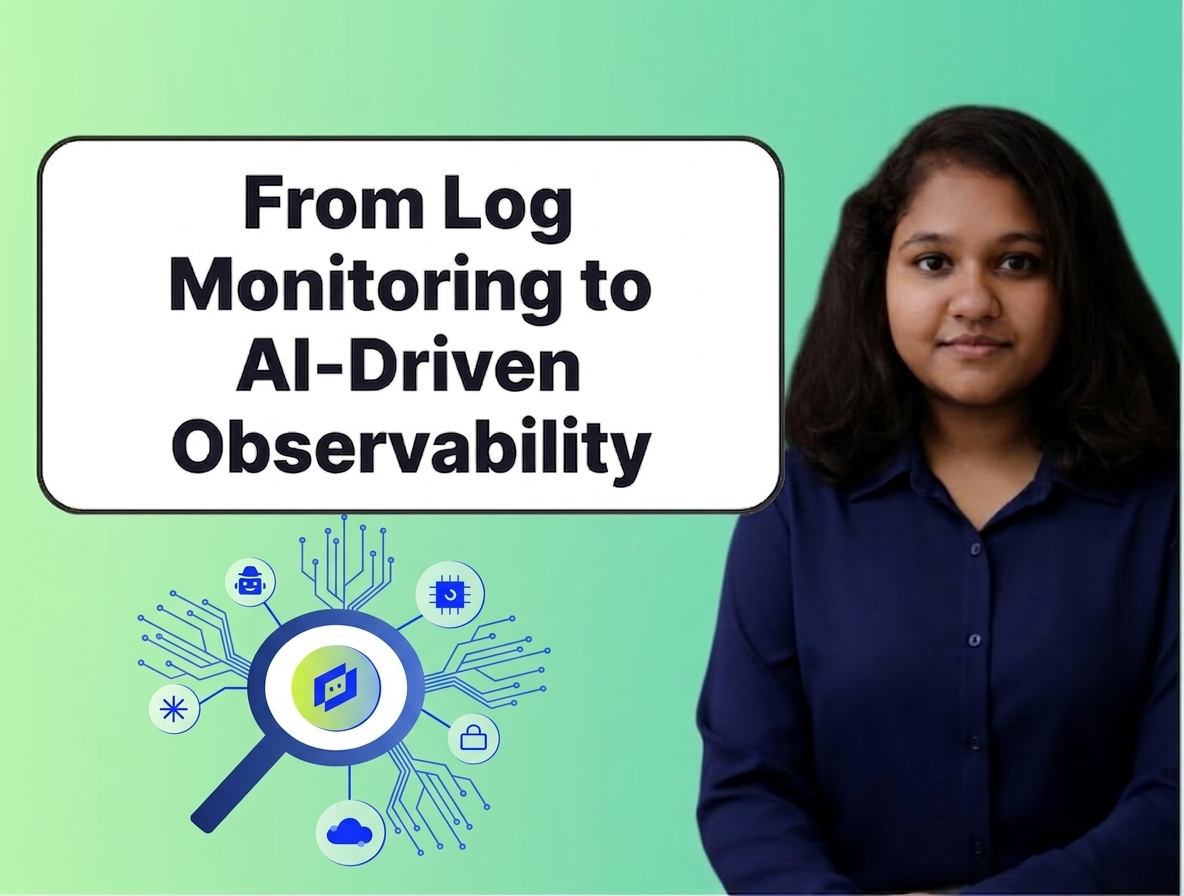
The journey from log monitoring to AI-driven observability is the story of engineering teams moving from reactive damage control to genuine system intelligence understanding not just what broke, but why it was always going to break.
Log Monitoring
Log monitoring was the first line of defence. Applications wrote timestamped records of events to files, and engineers queried those files when something broke. Tools like grep, Splunk, and the ELK Stack helped tame the volume but the approach stayed fundamentally reactive.
Reactive by nature
Text-based & unstructured
Siloed visibility
High noise, low signal
Log monitoring tells you that a failure occurred, but rarely why especially across distributed systems where a single user request may touch dozens of services.
Observability
As microservices and cloud-native architectures became the norm, a richer discipline emerged. Observability is the ability to infer the internal state of a system from its external outputs built on three foundational pillars:
Logs
Discrete, timestamped event records enriched with structured formats like JSON for easier querying.
Metrics
Numerical measurements over time CPU, latency, error rates. Ideal for dashboards and alerting thresholds.
Traces
End-to-end records of a request’s journey across services, revealing exactly where latency is introduced.
Platforms like Datadog, Grafana, Honeycomb, and OpenTelemetry made correlating these signals practical but still relied heavily on humans to ask the right questions.
Knowing why something happened is only useful if you find out fast enough to matter. At scale, the sheer volume of signals can overwhelm on-call engineers.
AI-Driven Observability
The latest evolution applies Artificial Intelligence and Machine Learning directly to observability data, transforming monitoring from a diagnostic tool into a predictive and autonomous system.
Anomaly Detection
ML models learn normal baselines, flagging deviations before they escalate — no manual thresholds needed.
Automated Root Cause Analysis
AI correlates signals across logs, metrics, and traces simultaneously — surfacing root cause in seconds.
Predictive Alerting
Instead of alerting when a threshold is breached, AI forecasts when a system will breach it — giving teams time to act.
Automated Remediation
Platforms trigger self-healing actions — restarting pods, scaling resources, rerouting traffic — without human intervention.
Platforms leading this space: Dynatrace (Davis AI), New Relic AI, Elastic Observability, and Google Cloud AIOps.
Summary
The evolution from log files to AI-driven observability is not just a tooling upgrade it is a fundamental rethinking of how we relate to system complexity. Modern distributed systems generate more data than any human team can manually analyse in real time. AI closes that gap.
Log Monitoring
Reactive
→
Observability
Investigative
→
AI Observability
Proactive
For engineering teams operating at scale today, AI-driven observability is no longer a luxury it is the operational backbone that makes reliability, speed, and confident deployment possible.
The question is no longer “What went wrong?” it is “How do we ensure it never goes wrong in the first place?”