CoDeKu DevOps Academy Blog - DevOps & Cloud Blogging Platform
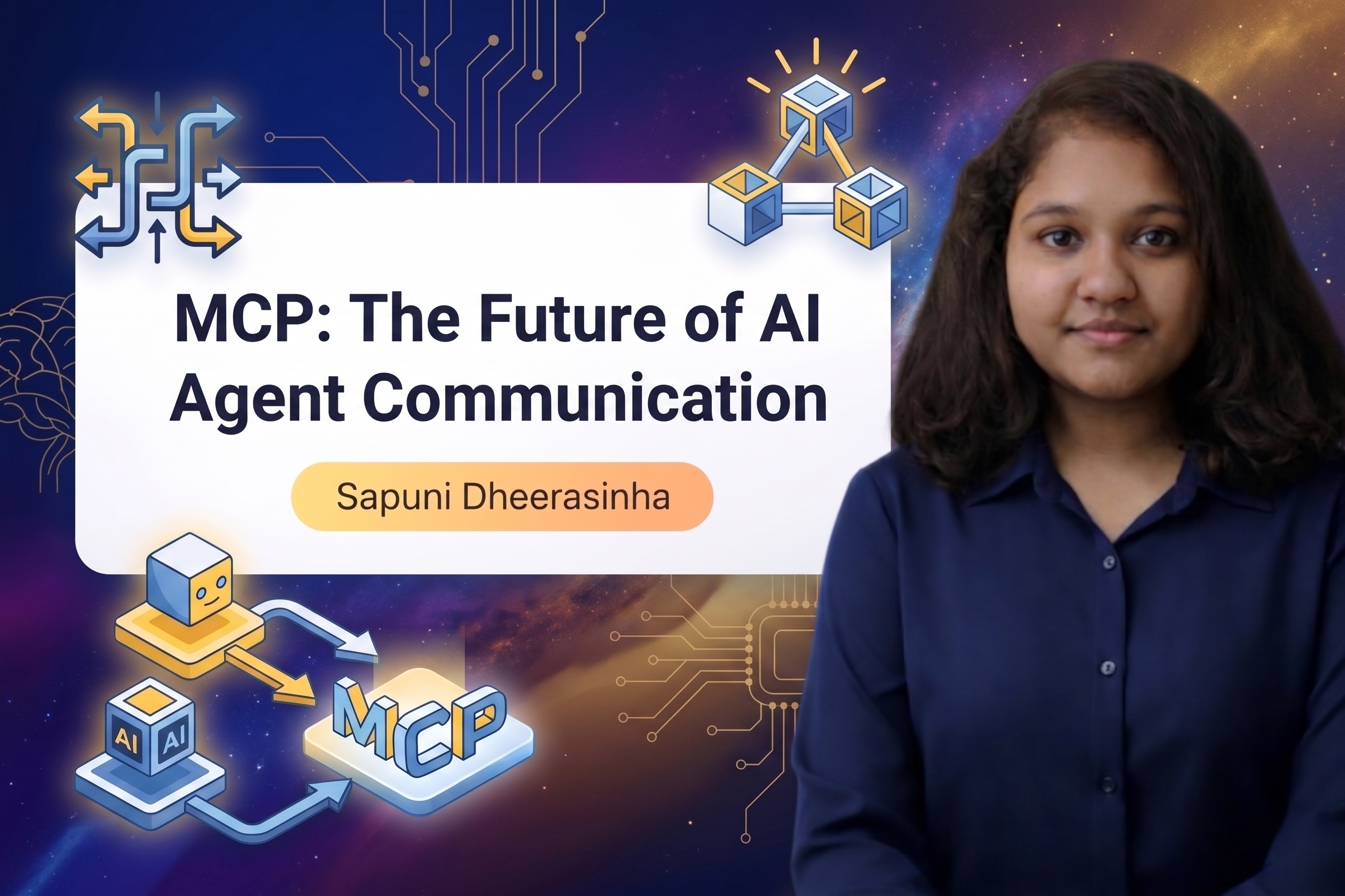

Model Context Protocol
MCP is not just another technical specification it is the defining infrastructure of how AI systems will communicate, collaborate, and scale in the years ahead.
01 Introduction
If you have been paying attention to the AI engineering world, you already know that building a chatbot is the easy part. The hard part the part that separates demos from production is connecting that chatbot to real systems. A bank database. A GitHub repository. A calendar. An internal CRM.
Every team ends up writing the same glue code, over and over again, for every new model and every new tool. It is messy, brittle, and expensive to maintain.
That is the problem Anthropic set out to solve when they open-sourced the Model Context Protocol (MCP) in November 2024. Since then, MCP has quietly become the most important infrastructure conversation in AI engineering not because it is flashy, but because it is necessary.
02 What is MCP?
Model Context Protocol is an open standard that defines how AI models, tools, data sources, and external systems talk to each other. Think of it as a universal communication layer a common language that any AI model can use to connect with any tool, regardless of who built either one.
Analogy
Think of USB-C. Before it, every device needed its own cable, its own port, its own adapter. USB-C standardised the interface so any device could talk to any other device. MCP does the same thing for AI any model, any tool, one protocol.
The MCP architecture has three core components:
MCP Host
The AI Application
Claude, VS Code, Cursor any AI-powered application that needs to call tools.
MCP Client
The Protocol Layer
Handles protocol negotiation, message routing, and capability discovery between host and server.
MCP Server
The Tool Provider
A lightweight service that exposes files, databases, or APIs in a structured, model-readable format.
AI Model
Claude / GPT
Claude / GPT
⇄
MCP Client
JSON-RPC 2.0
JSON-RPC 2.0
⇄
MCP Server
Tools & Data
Tools & Data
⇄
External
APIs / DBs
APIs / DBs
MCP Communication Flow · HTTP/SSE or stdio transport
Communication travels via JSON-RPC 2.0 over either HTTP with Server-Sent Events (SSE) or standard input/output (stdio) transport. Intentionally simple easy to implement, easy to debug, easy to extend.
03 Why Does MCP Exist?
Before MCP, every AI integration was hand-crafted. You picked a model. You picked a tool. You wrote custom adapter code to connect the two. Then you switched models and rewrote everything. Then you added another tool more code. The complexity scaled quadratically.
N × M integrations
N models × M tools = exponential maintenance cost. Unmaintainable at scale.
N + M integrations
With MCP every model and every tool speaks the same language. One server works with all clients.
Beyond integration complexity, MCP solves the context problem through three primitives:
T
Tools
Executable functions the model can call search the web, write a file, query a database, send an API request.
R
Resources
Structured context files, database records, web content exposed in a format the model can read and reason over.
P
Prompts
Reusable, parameterised prompt templates that define how the model should behave in specific contexts.
04 Real-World Examples
MCP is already running in serious engineering environments. By early 2025, there are over 1,000 publicly available MCP servers spanning every major developer tool and service.
🐙
GitHub MCP Server
Browse repositories, create issues, review pull requests, read commit history all via natural language, directly through the GitHub API. Claude Code is the flagship example.
🗄️
Database Access
PostgreSQL and SQLite MCP servers let an AI agent execute queries, analyse results, and explain data without ever exposing raw credentials or bypassing permission controls.
🌐
Browser Automation
Playwright and Puppeteer MCP servers allow an agent to control a real browser fill forms, take screenshots, scrape structured data all driven by natural language.
📧
Email & Calendar
Gmail and Google Calendar integrations let agents schedule meetings, draft replies, and summarise threads with the actual inbox as live context, not a static snapshot.
05 Why Developers Love It
Beyond solving the integration problem, MCP brings properties that matter deeply in production engineering environments.
🔀
Vendor-Agnostic by Design
Write your MCP server once and it works with Claude, GPT, Gemini, or any MCP-compatible model. Swap models without touching your tool code. This is the end of vendor lock-in for AI tooling.
🔒
Security by Design
MCP follows an explicit permission model. Every tool call is transparent what is being called, what data is leaving the system, what the agent is doing. For production and regulated industries, this auditability is critical.
📦
Reusable, Shareable Servers
Build an MCP server once, publish it, and the entire community benefits. Anthropic already maintains a growing collection of official servers. The ecosystem is compounding rapidly.
🤖
Agentic Workflows Unlocked
MCP is the missing foundation for truly autonomous agents not just chat that calls one tool, but multi-step workflows where an agent plans, executes, checks results, and continues. The architecture scales from simple chatbots to fully autonomous systems.
06 Where MCP Is Going
“MCP is to AI agents what HTTP was to the web a common language that lets everything talk to everything.”
Anthropic released MCP specification version 2.0 in December 2025. Microsoft, Google, and OpenAI have all moved toward MCP compatibility signalling that this is becoming the industry standard, not one company’s proprietary protocol.
The next two years will likely bring three major shifts:
🕸️
Multi-Agent Networks
Agents communicating with other agents via MCP, forming collaborative, distributed AI systems.
🏪
Open Marketplace
Discover, install, and trust-score MCP servers like npm packages a public registry for AI tools.
📱
Edge AI
MCP running directly on mobile devices and IoT sensors AI context at the edge, not just the cloud.
For developers in Sri Lanka and across South Asia this is a rare early-mover moment. Local companies building MCP servers for regional data sources, government APIs, or industry-specific tools are publishing into a global AI ecosystem that will compound in value as adoption grows.
07 How to Start Today
The MCP SDK is available in both Python and TypeScript. The documentation is solid, the community is active, and the barrier to your first working server is genuinely low.
# Python SDK
pip install mcp

# TypeScript / Node.js SDK
npm install @modelcontextprotocol/sdk

# Official documentation
# https://modelcontextprotocol.io/docs
💡 The fastest path to your first MCP server
Start with Anthropic’s
mcp-server-filesystem example it is three files, under 100 lines, and exposes your local file system to Claude Desktop. You will have a working AI + tool integration running in under 20 minutes. That first moment when Claude reads a file on your machine through a server you built changes how you think about what is possible.
→ Final Thought
MCP is easy to write about. But you will not fully understand it until you experience that first moment an AI agent browsing your GitHub repository, querying your database, checking your calendar, all in a single natural language conversation.
That moment reframes everything. It stops being a chat interface and starts being an agent that can actually work.
If you are a student or a junior developer learning MCP right now you are ahead of the curve. The engineers who define the infrastructure of this AI era are working on exactly this problem. You could be one of them.